Choosing among China’s best WPC exterior panel suppliers requires more than comparing catalogue prices. A reliable supplier should demonstrate material knowledge, stable production, and clear quality records. Wpc Exterior Panel products combine wood fibers and polymers, creating practical cladding for façades, balconies, garden walls, and commercial entrances. However, performance depends on formulation, surface treatment, installation, and local climate.
Experienced buyers should examine technical data before trusting attractive product photographs. Ask about density, water absorption, color stability, fire performance, screw holding, and thermal expansion. Request recent samples, not only showroom pieces. A good sample should show consistent texture, clean edges, and a finish that remains convincing under natural light. Factory visits or verified video inspections can reveal extrusion lines, storage conditions, and quality-control procedures. Small details matter.
Supplier credibility also comes from communication after the quotation. Does the team explain limitations honestly? Can it provide installation guidance, test reports, packaging photos, and replacement policies? These questions often separate a dependable manufacturer from a trading company with limited technical control. Certifications may support a decision, but they should be checked against the actual product and production site. Paperwork alone proves little.
This guide reviews key factors for identifying capable Chinese suppliers, including manufacturing experience, customization, export support, and project references. It also considers practical risks, such as shade variation between batches and unexpected expansion during hot weather. No supplier is perfect. Even a strong factory may need closer supervision for a complex project. Careful verification creates a better chance of receiving durable panels, accurate dimensions, and service that remains useful after shipment.
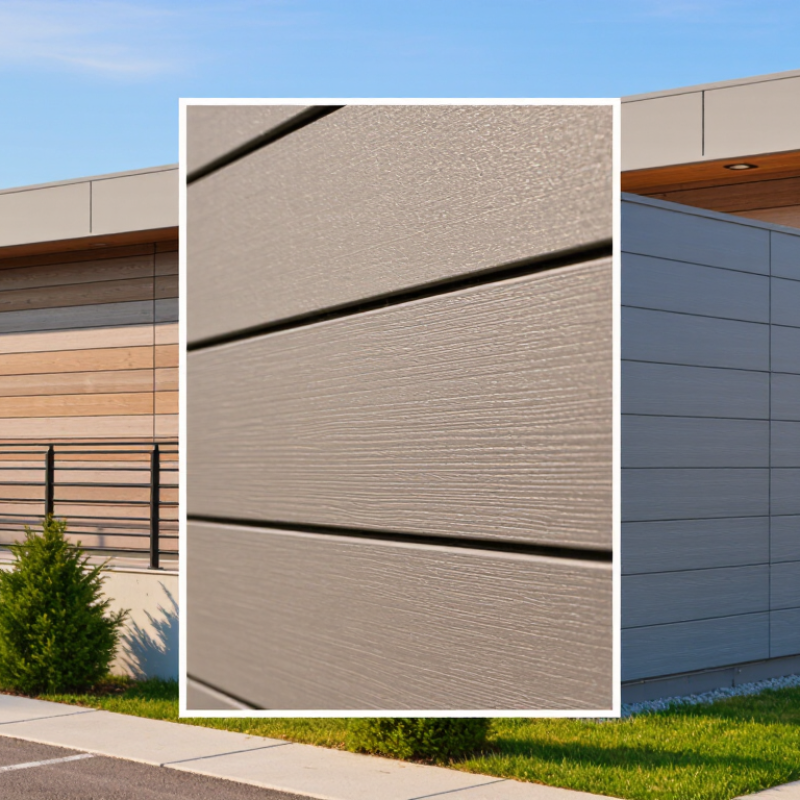
WPC exterior panels are engineered boards made from wood fibers or flour, thermoplastic resin, and performance additives. The mixture is heated, blended, and pressed or extruded into façade panels, screens, soffits, or decorative cladding. They resemble timber, but their composition is more consistent. Small wood particles create texture, while polymer helps reduce water absorption and surface cracking.
According to Grand View Research, the global wood plastic composites market was valued at about USD 7.4 billion in 2023. Its report forecasts continued growth through 2030, supported by construction and outdoor renovation demand. However, market growth does not make every panel suitable for every wall. Exterior panels still need testing for moisture, ultraviolet exposure, impact, fire performance, and dimensional movement. ASTM D7031 offers evaluation guidance for wood-plastic composite products, although project specifications may require additional testing.
Installation details matter. I have seen panels fail when installers ignored ventilation gaps behind the cladding. Dark colors can become very hot in direct sunlight. Thermal expansion may then loosen fasteners or open joints. WPC is not maintenance-free, either. Dust, algae, and standing water still need attention. A reliable supplier should provide resin content, density, fire data, water absorption results, and recommended fixing spacing. One weakness remains clear: recycled content can vary between batches, so appearance and stiffness may not always match the sample.
China Best WPC Exterior Panel Suppliers?
WPC exterior panels combine wood fibers with thermoplastic polymers and stabilizing additives. Their main strengths include moisture resistance, low maintenance, and consistent surface texture. Unlike untreated timber, they resist rot and insect damage under normal outdoor exposure. However, they are not completely maintenance-free. Dust, algae, and surface scratches still require attention.
In practice, WPC panels suit façades, balcony screens, garden walls, soffits, and covered outdoor ceilings. Their warm grain can soften concrete or metal surroundings. Panels with concealed clips create cleaner lines, while ventilated substructures help manage trapped moisture. Leave expansion gaps around edges. Thermal movement is easy to underestimate, especially on dark panels exposed to strong sun.
Quality depends on fiber content, extrusion control, UV stabilizers, and accurate installation. Experienced suppliers should provide technical data, fire-performance reports, colorfastness results, and batch information. Ask for samples before ordering. A small sample may reveal texture variation, odor, or color changes that photographs hide. Coastal sites need stronger corrosion protection for fixings. High-traffic areas may still suffer dents. WPC is usually decorative, not structural, so the supporting wall must carry the load. Some specifications look impressive on paper, yet site conditions can prove different.
How to Assess WPC Exterior Panel Suppliers
A reliable supplier should prove performance, not only display attractive panels. Grand View Research estimated the global wood plastic composites market at about USD 7.1 billion in 2023, with strong growth expected through 2030. This expansion also increases the risk of inconsistent quality. Ask for resin type, wood content, density, water absorption, and production tolerances. Market estimates differ, so transparent documentation matters more than impressive forecasts.
For exterior use, request test results for weathering, impact, slip resistance, and fire behavior. ISO 4892-3 supports accelerated ultraviolet exposure testing, while EN 15534 covers important WPC characteristics. Check test duration, specimen thickness, and laboratory accreditation. A report without these details is weak evidence. Also inspect a factory sample after cutting and drilling. Color consistency, hidden voids, edge strength, and fastener holding can reveal problems that brochures hide.
Experience matters during installation. Ask whether the supplier provides expansion gaps, substructure spacing, drainage details, and replacement guidance. The Freedonia Group’s industry research highlights construction demand as a major application driver, but outdoor conditions vary sharply by region. A panel tested in a dry climate may behave differently beside a humid coast. No supplier is perfect. I would still request a small pilot order, record defects, and compare results after several months. That extra step feels slower, but it can expose assumptions before a full project begins.
| No. | Assessment Dimension | Suggested Weight | Recommended Screening Benchmark | Evidence to Request | Evaluation Method |
|---|---|---|---|---|---|
| 1 | Product Composition | 10% | Clearly defined polymer, wood-fiber or mineral filler, additives, and layer structure. The formulation should remain consistent between approved samples and mass production. | Technical data sheet, material declaration, cross-section specification, and batch-control procedure. | Compare the declared formulation with an independent laboratory composition check and approved reference sample. |
| 2 | Dimensional Stability | 12% | Require documented thickness, width, length, squareness, and dimensional-change limits for the intended temperature and humidity range. Expansion gaps must be defined in the installation guide. | Dimensional inspection report, thermal-cycling results, moisture-conditioning results, and installation tolerances. | Verify samples before and after conditioning; assess whether movement is compatible with the project’s joint design. |
| 3 | Mechanical Performance | 10% | Published flexural strength, flexural modulus, tensile properties, impact resistance, and fastener-holding performance must match the panel’s intended span and fixing method. | Laboratory test reports, load tables, allowable span data, and fixing-system details. | Check test methods such as ASTM D790 for flexural properties and confirm that reported values are based on the actual panel construction. |
| 4 | Water and Moisture Resistance | 10% | The panel should have documented water absorption, thickness swelling, wet-dry cycling, and edge-sealing performance suitable for exterior exposure. | Water-absorption and swelling reports, wet-dry cycle results, drainage details, and edge-treatment specification. | Compare conditioned samples with dry controls and inspect swelling, delamination, cracking, and surface whitening. |
| 5 | Weathering and UV Resistance | 12% | Accelerated-weathering data should cover color change, chalking, cracking, flaking, and loss of mechanical performance. The exposure cycle must be stated rather than described only as “UV resistant.” | UV or xenon-arc test report, color-change readings, visual ratings, exposure cycle, and post-weathering mechanical results. | Check whether testing follows a recognized method such as ASTM G154 or ISO 4892-2 and compare results against the project’s appearance requirements. |
| 6 | Fire Performance | 10% | Fire classification must be selected according to the destination-market building code. Do not accept a general “fireproof” statement without a tested classification for the exact panel assembly. | Reaction-to-fire report, flame-spread or smoke-development data where applicable, and tested assembly details. | Verify whether the report uses the required local method, such as ASTM E84 or EN 13501-1, and confirm that thickness and surface finish match the supplied product. |
| 7 | Surface Finish and Color Consistency | 8% | Texture, gloss, color tolerance, coating thickness, and acceptable visual defects should be defined in a written quality standard. | Approved color standard, inspection limit samples, gloss or color measurements, coating specification, and packaging photographs. | Inspect samples under consistent lighting and measure color difference where color matching is commercially important. |
| 8 | Quality Management and Traceability | 10% | Each production batch should be traceable to raw materials, production date, operator or line, inspection results, and shipment records. | Quality manual, inspection plan, calibration records, nonconformance procedure, and batch labels. | Audit a sample batch record from incoming material through final packing and verify that test equipment is calibrated. |
| 9 | Production Capacity and Lead Time | 6% | Capacity claims should be supported by production-line information, realistic monthly output, confirmed minimum order quantity, and a documented lead-time range. | Capacity statement, production schedule, sample order timeline, monthly output records, and contingency plan. | Compare promised delivery dates with historical records and allow time for inspection, export documentation, and transit. |
| 10 | Installation System and Technical Support | 7% | The supplier should provide fastening, substructure, joint, corner, ventilation, cutting, and maintenance instructions for the actual panel profile. | Installation manual, CAD or detail drawings, accessory list, warranty terms, and technical response procedure. | Review details for drainage and ventilation, then conduct a small installation trial before approving a large order. |
| 11 | Compliance and Sustainability Documentation | 3% | Environmental and regulatory claims should identify the tested product, applicable jurisdiction, test date, and certification scope. Recycled-content claims should be measurable and documented. | Declaration of compliance, recycled-content statement, safety data where relevant, and environmental test documentation. | Check document validity, product scope, issuing body, and consistency with customs and project requirements. |
| 12 | Commercial Terms and Total Cost | 2% | Evaluate total delivered cost rather than panel price alone, including tooling, accessories, packaging, inspection, freight, duties, replacement material, and warranty obligations. | Formal quotation, payment terms, Incoterm, packaging specification, warranty policy, and replacement procedure. | Build a landed-cost comparison using identical specifications, quantities, destination, and service requirements. |
| Total Evaluation Weight | 100% | Prioritize independently verified performance, product consistency, and suitability for the destination-market building requirements. | |||
China Best WPC Exterior Panel Suppliers?
Top Regions for Reliable WPC Exterior Panel Suppliers
Guangdong is a practical starting point for WPC exterior panel sourcing. Suppliers there often understand humid, coastal conditions and export packaging. Many factories operate extrusion lines, surface embossing equipment, and color-matching laboratories. Ask for water absorption data and UV-aging results. A bright sample can still fade after one summer.
Zhejiang and Jiangsu offer strong manufacturing networks for construction materials. Their suppliers commonly provide custom profiles, hidden-fixing systems, and stable dimensional control. These regions also have efficient road, rail, and port connections. Request production samples from different batches. One sample proves very little. Check thickness, weight, locking accuracy, and surface consistency.
Shandong is worth considering for larger projects and competitive material supply. Several manufacturers have access to wood-plastic compounds, additives, and industrial-scale production. This can support steady volumes, but lower pricing needs careful review. Confirm the recycled wood and polymer proportions. Review fire-performance documents, installation guidance, and outdoor exposure records. A supplier should explain maintenance in plain language, not only present attractive certificates.
Regional reputation is useful, but factory evidence matters more. Visit the production floor when possible. Inspect storage conditions, moisture control, and packing methods. Ask how rejected panels are handled. My own preference is a supplier that admits limitations and proposes testing. No region is perfect. Local climate experience, technical communication, and consistent quality should guide the final decision.
When choosing a China-based WPC exterior panel supplier, start with the application, not the catalog. Ask for material composition, density, panel dimensions, surface finish, and color tolerances. A reliable supplier should explain how wood fiber and polymer content affect expansion, weight, and machining. Request current technical data sheets and independent test reports. Do not accept “weatherproof” without test conditions.
Order physical samples. Inspect the surface in sunlight, then check the back for warping, voids, and uneven profiles. Small details matter. Test several batches when possible, because one attractive sample may not represent regular production. Ask about ultraviolet resistance, moisture absorption, slip performance, and fire classification. Confirm which standards the reports follow and whether the laboratory can be verified. A supplier with technical staff should answer clearly, not redirect every question to sales personnel.
Review production capacity, quality-control procedures, packaging, lead times, and replacement policies. Request photos or videos from the actual factory, but treat them as supporting evidence. A video is not an audit. Discuss tolerances in writing, including length, thickness, color variation, and allowable defects. Ask for installation guidance and maintenance instructions before placing a large order. Even experienced buyers can overlook after-sales support. A low price may become expensive when panels arrive damaged or technical replies take several days. Clear communication is not glamorous, but it often protects the project.
A practical procurement model for comparing WPC exterior panel suppliers. The weighting focuses on measurable product quality, durability, compliance, supply capability, and service rather than company or brand names.
How to use this chart: Ask each supplier for test reports, technical datasheets, production samples, warranty terms, and delivery records. Give higher priority to weather resistance, dimensional stability, safety compliance, and consistent quality when selecting WPC exterior panels for long-term outdoor use.
1272 Speers Rd Unit 4
Oakville ON Canada L6L 2X4
©Copyright 2020 Gosco Valves. All rights reserved.