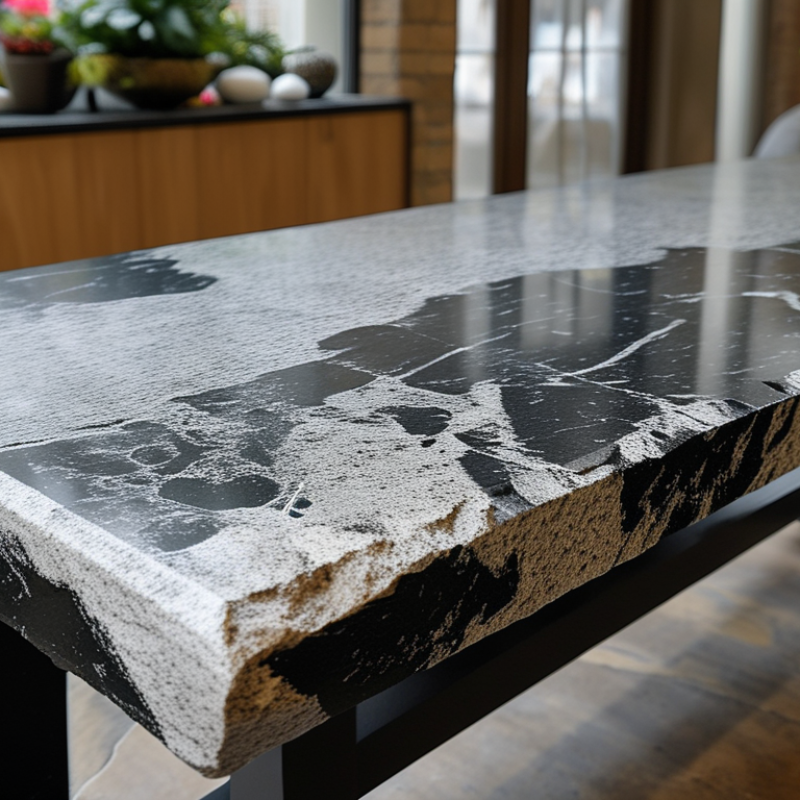
| Granite Type | Sound, durable natural granite suitable for structural, architectural, landscaping, or memorial applications | Petrographic examination and visual inspection | Confirms that the material is genuine granite and appropriate for the intended service environment. |
| Bulk Density | Approximately 2,600–2,800 kg/m³ | EN 1936 or ASTM C97/C97M | Higher density generally indicates a compact stone with good mass, durability, and dimensional stability. |
| Water Absorption | Preferably ≤0.5% by mass; lower values are advantageous for exterior use | EN 13755 or ASTM C97/C97M | Low absorption improves resistance to staining, freeze–thaw damage, moisture penetration, and weathering. |
| Compressive Strength | Commonly ≥100 MPa for high-quality granite; project specifications may require higher values | EN 1926 or ASTM C170/C170M | Indicates the stone’s capacity to withstand heavy loads and compression during service. |
| Flexural Strength | Typically ≥8 MPa, subject to thickness, orientation, and application requirements | EN 12372 or ASTM C880/C880M | Important for slabs, raised elements, projecting components, and bases exposed to bending forces. |
| Abrasion Resistance | Low material loss and a stable surface finish under the specified test procedure | EN 14157 or applicable local standard | Helps maintain appearance and dimensional accuracy in floors, steps, entrances, and high-traffic areas. |
| Freeze–Thaw Performance | No significant cracking, scaling, or strength loss after the required number of cycles | EN 12371 or ASTM C666/C666M where applicable | Essential for outdoor bases and installations in climates with repeated freezing and thawing. |
| Dimensional Accuracy | Consistent length, width, thickness, squareness, and edge straightness within agreed project tolerances | Approved shop drawings and project tolerances | Accurate dimensions simplify installation, reduce site adjustment, and improve joint alignment. |
| Surface Finish | Uniform polished, honed, flamed, bush-hammered, or sandblasted finish with no visible processing defects | Approved physical sample and visual inspection under suitable lighting | Controls color consistency, texture, slip characteristics, and the final architectural appearance. |
| Visual Quality | Consistent color and grain with no open cracks, unstable veins, resin-filled structural defects, or excessive pits | Reference sample, approved range, and pre-shipment inspection | Reduces disputes caused by natural variation and ensures the delivered material matches expectations. |
| Edge and Corner Integrity | Clean, accurately finished edges with no chips, corner breaks, or concealed repairs | Piece-by-piece visual inspection and dimensional check | Protects handling safety, installation quality, and the finished appearance of exposed bases. |
| Flatness and Stability | No warping or rocking; contact surfaces are properly leveled and prepared | Straightedge, level, and dry-fit inspection | Improves load distribution and prevents movement, cracking, or unsafe installation conditions. |
| Chemical and Stain Resistance | No visible etching or permanent staining under the chemicals expected in the application | Project-specific compatibility and stain testing | Supports long-term performance where the base may contact cleaning agents, salts, oils, or pollutants. |
| Traceability and Inspection | Documented quarry block, production batch, inspection record, and packing identification | Inspection report, packing list, photographs, and test certificates | Makes quality claims verifiable and simplifies replacement, customs, and project documentation. |
| Packaging and Export Readiness | Moisture-protected, securely crated, clearly marked, and packed to prevent impact damage during international transport | Pre-shipment packing inspection and agreed shipping requirements | Reduces breakage, handling losses, delays, and claims across long-distance supply chains. |