Choosing Open Frame Generator Sets requires more than comparing engine power and purchase prices. Site conditions matter. So do maintenance access, noise tolerance, fuel quality, and expected loading.
The International Energy Agency’s Electricity 2024 report projects global electricity demand will grow by about 4% annually through 2026. That growth increases pressure on temporary, standby, and distributed power systems. MarketsandMarkets also identifies rising construction activity, telecommunications expansion, and unreliable grids as important generator-set demand drivers. These trends explain why open-frame models remain practical for workshops, farms, construction sites, and outdoor events. Their exposed architecture improves airflow and simplifies access to filters, belts, batteries, and control panels. It also increases exposure to dust, rain, and accidental contact. That trade-off is easy to underestimate.
Energy expert Fatih Birol has said, “Electricity is the new oil.” His statement is not specifically about generator sets, but it captures their growing operational importance. A generator is valuable only when it starts reliably, carries the real load, and receives disciplined servicing. Small details matter. A warm-up cycle. A clean fuel filter. A dry control panel.
This guide compares engine ratings, alternator quality, fuel consumption, emissions performance, sound levels, portability, and protection requirements. Manufacturer claims deserve careful checking. Some published fuel figures reflect ideal laboratory conditions, not a muddy jobsite at 80% load. That difference can change the buying decision.
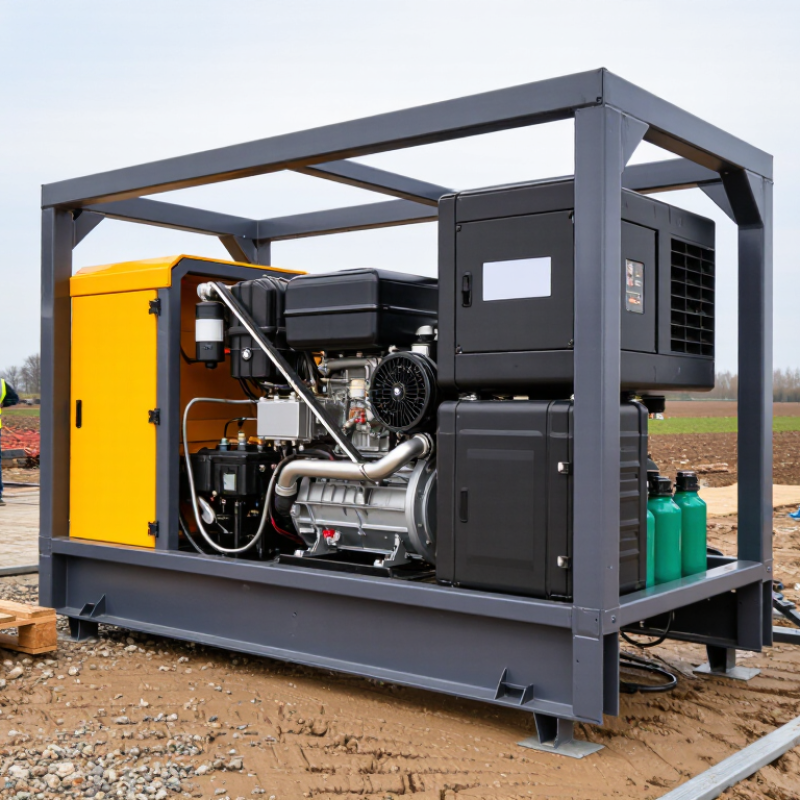
How to Choose Open Frame Generator Sets?
An open frame generator set exposes its engine, alternator, and control panel on a steel skid. This design improves airflow and makes routine servicing easier. Filters, belts, terminals, and coolant connections remain visible. Technicians can inspect them quickly, even on busy construction sites.
The design also reduces enclosure weight and purchase cost. However, it provides limited protection against rain, dust, and accidental contact. Noise can travel farther than expected. Choose an open frame model for dry plant rooms, supervised worksites, farms, or temporary indoor power. Outdoor use requires a suitable canopy, weather protection, and safe ventilation. It is not a universal solution.
Application determines the correct rating. ISO 8528 distinguishes standby, prime, and continuous operating duties. A load study should include motors, pumps, heaters, and starting currents. Oversizing may cause poor loading and incomplete combustion. Undersizing can trigger voltage dips and thermal stress. The International Energy Agency reported that data centers used about 460 TWh globally in 2022, with demand potentially exceeding 1,000 TWh by 2026. That growth increases the need for dependable backup systems, but not every site needs a large generator. Uptime Institute’s 2024 outage analysis reported that 54% of serious data-center outages created costs above $100,000. Automatic transfer systems, fuel quality, grounding, and weekly inspections deserve equal attention. In practice, buyers often focus on kilowatts and overlook access space. That is an expensive assumption. For final selection, compare measured load behavior, local emissions requirements, acoustic limits, and maintenance access. Forecasts can change. Your site conditions are harder to ignore.
| Selection Dimension | Typical Data or Range | Open Frame Design Consideration | Suitable Applications | Practical Selection Guidance |
|---|---|---|---|---|
| Rated Output | Approximately 2–2,000 kVA, depending on the engine and alternator configuration | Open frame construction provides direct access to the engine, alternator, control panel, and service points. | Residential backup, retail facilities, workshops, construction sites, agricultural operations, and industrial standby power. | Choose a set with enough capacity for continuous loads, starting currents, and future expansion. Avoid sizing only from the total running wattage. |
| Prime vs. Standby Rating | Prime-rated units support variable loads for extended operation; standby-rated units are intended for emergency use during utility outages. | The open frame format is available in both rating types, but cooling, fuel-system, and maintenance requirements may differ by model. | Prime power: remote sites and temporary power. Standby power: homes, offices, data rooms, and commercial buildings. | Use the prime rating when the generator will operate regularly. Use the standby rating only when operation is limited to utility interruptions and testing. |
| Voltage and Frequency | Common systems include 120/240 V single-phase and 208/120 V, 400/230 V, or 480/277 V three-phase; 50 or 60 Hz operation is common. | The alternator and control system must match the electrical distribution system and connected equipment. | Residential systems generally use single-phase output; commercial and industrial installations commonly use three-phase output. | Confirm voltage, phase, frequency, grounding method, and allowable voltage variation before purchase. |
| Engine Fuel | Diesel is common for medium and large units; gasoline is often used for smaller portable units; natural gas or LPG may be used where available. | Fuel choice affects operating cost, storage requirements, emissions, cold-start performance, and service intervals. | Diesel: heavy-duty and long-duration use. Gasoline: light-duty and portable use. Gas or LPG: locations with suitable fuel infrastructure. | Select fuel based on operating hours, local availability, required storage duration, safety regulations, and total cost of ownership. |
| Cooling System | Air-cooled systems are common at lower outputs; liquid-cooled systems are generally used for higher outputs and extended duty. | Open frames allow strong airflow around the radiator or engine but provide limited protection from dust, rain, and debris. | Air-cooled: light construction and residential backup. Liquid-cooled: industrial, commercial, and long-running applications. | Check ambient temperature, altitude, ventilation, radiator clearance, and heat rejection requirements at the installation site. |
| Noise Level | Often about 70–100 dB(A) at 7 m, depending on engine size, load, exhaust system, and measurement conditions. | Open frames generally produce more mechanical and exhaust noise than enclosed or sound-attenuated sets. | Construction areas, farms, industrial yards, utility works, and other locations where moderate-to-high noise is acceptable. | For residential areas, offices, schools, and healthcare facilities, consider acoustic treatment, a separate enclosure, or an enclosed generator design. |
| Weather and Environmental Protection | Basic open frames normally provide little or no weather protection unless a canopy or shelter is added. | Exposure to rain, snow, salt air, dust, and direct sunlight can accelerate corrosion and affect reliability. | Covered construction sites, ventilated utility rooms, agricultural buildings, and protected industrial spaces. | Install on a level foundation under a suitable roof or weather canopy while maintaining required airflow and service access. |
| Mobility | Small units may use wheels or lifting handles; larger sets may include lifting points, skids, or trailer-mounted frames. | The exposed frame can simplify lifting and transport, but the structure must be rated for the generator’s total operating weight. | Temporary construction power, events, emergency response, roadwork, and remote maintenance projects. | Verify total weight, lifting points, trailer requirements, center of gravity, and site access before transportation. |
| Fuel Tank Capacity | Common integrated tank sizes support approximately 8–24 hours of operation, depending on load and generator size. | A larger tank increases operating autonomy but also increases footprint, weight, spill-control requirements, and fuel-management needs. | Remote sites, emergency backup, temporary power, and applications where frequent refueling is inconvenient. | Estimate fuel consumption at the expected average load rather than at no-load or full-load conditions only. |
| Load Starting Capability | Motors, pumps, compressors, transformers, and HVAC systems may require several times their running current during startup. | The alternator, engine governor, and voltage regulator must recover quickly from transient load changes. | Water pumps, refrigeration, elevators, workshop machinery, air compressors, and agricultural equipment. | List all motor loads and their starting methods. Consider sequential starting or a larger alternator when voltage dip is a concern. |
| Control and Protection | Common functions include start/stop control, emergency shutdown, overload protection, low oil pressure, high coolant temperature, and over/under-voltage monitoring. | The open frame layout makes the control panel easy to access, inspect, and replace, but it should be protected from unauthorized contact and moisture. | Manual operation, automatic backup systems, temporary power distribution, and basic remote monitoring. | For standby applications, confirm compatibility with an automatic transfer switch and verify alarm, communication, and remote-start functions. |
| Maintenance Access | Routine checks may include engine oil, coolant, filters, belts, battery condition, exhaust components, and electrical connections. | Open frames normally offer excellent visibility and access, reducing service time compared with enclosed designs. | Fleet operations, rental equipment, construction contractors, farms, workshops, and facilities with in-house technicians. | Maintain clear service space around the unit and follow the engine manufacturer’s maintenance schedule and fluid specifications. |
| Installation Surface | A rigid, level, non-combustible base is recommended; reinforced concrete is commonly used for permanent installations. | Vibration isolators or resilient mounts may be needed to reduce structural transmission and protect connected piping or cabling. | Outdoor pads, plant rooms with adequate ventilation, construction compounds, and utility service areas. | Check foundation strength, drainage, anchoring, vibration control, exhaust routing, and access for fuel delivery and maintenance. |
| Electrical Connection | Connection may use a temporary distribution board, circuit breaker, manual transfer switch, or automatic transfer switch. | Exposed terminals and cable entries require protection from impact, moisture, incorrect wiring, and unauthorized access. | Temporary distribution, emergency power, construction sites, commercial facilities, and industrial backup systems. | Use correctly sized cables, protective devices, grounding conductors, and transfer equipment in accordance with local electrical codes. |
| Emissions and Compliance | Requirements vary by engine power, fuel type, location, operating hours, and local environmental regulations. | Open frame construction does not reduce exhaust emissions; the installation must provide safe exhaust discharge and adequate ventilation. | Outdoor industrial sites, construction projects, agricultural facilities, and regulated commercial installations. | Confirm applicable emissions, noise, fuel-storage, electrical, and workplace-safety requirements before selecting the generator. |
| Best Overall Use Case | Applications prioritizing accessibility, portability, serviceability, and lower initial equipment cost. | Open frame sets are practical where the generator can be placed in a secure, ventilated, and weather-protected location. | Temporary power, industrial yards, workshops, farms, construction projects, and protected generator rooms. | Choose an open frame set when noise, security, and weather exposure can be managed effectively. Select an enclosed set when acoustic and environmental protection are higher priorities. |


©Copyright 2020 Gosco Valves. All rights reserved.