How to Choose the Best Tabletop Letterpress?
Choosing a Tabletop Letterpress is less about buying the smallest press and more about matching its capabilities to your work. Will you print business cards, wedding invitations, small art editions, or short packaging runs? A press that feels solid on a workbench may still struggle with larger sheets, thick stock, or consistent impression. These details matter. So does the space around the machine: room for paper, type, ink, and safe, careful adjustments.
Industry reports offer useful context, though they do not replace hands-on testing. Smithers’ The Future of Global Printing to 2028 analyzes market shifts across print processes and applications. FESPA’s Print Census reports on print businesses’ priorities and operating pressures. Neither report ranks tabletop presses, but both help explain why flexibility, setup time, and repeatable quality deserve attention. Treat broad market data as context, not a promise about any one machine.
A practical comparison should examine platen size, available printing area, construction, roller adjustment, replacement parts, and the maker’s support. Ask how the press handles the exact paper you plan to use. If possible, inspect a sample impression and test registration before committing. Small differences show up quickly: uneven ink on a textured sheet, a faint edge, or a sheet that shifts during a second pass. I have to admit, specifications can look reassuring on paper; real results may be less tidy. The right choice is the press you can operate, maintain, and use consistently—not simply the one with the most impressive description.
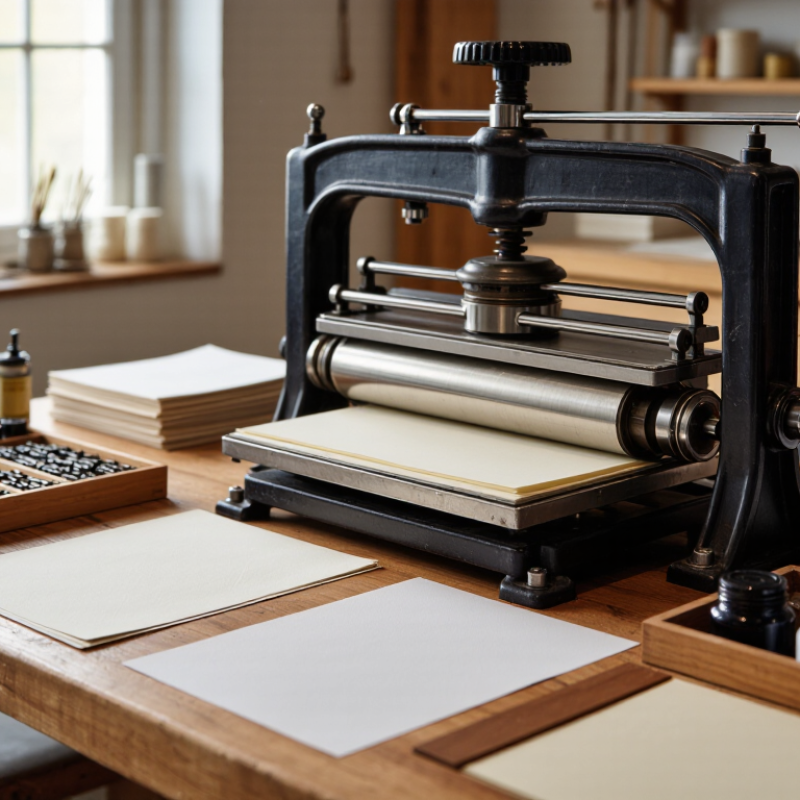
Define Your Print Format by Comparing Sheet, Platen, and Chase Dimensions
A tabletop letterpress must fit the sheet you plan to print, not just the artwork. Start with the finished trim size, then allow room for grippers, registration, and trimming. ISO 216:2007 gives standard A-series dimensions: A4 is 210 × 297 mm, while A3 is 297 × 420 mm. These figures describe paper sizes, not a press’s printable area. A useful sheet may need to be smaller than the machine’s stated maximum. Measure a real sheet, too; nominal sizes do not reveal curl or uneven edges.
Compare three measurements before choosing a press. The sheet size is the stock you feed in. The platen size is the surface that carries the printing form and affects the available impression area. The chase’s usable opening must fit the locked-up type or plate, furniture, and quoins. Small details matter. A few millimetres can change whether a form fits securely. Ask for the maximum sheet, platen, and chase dimensions separately, then check them against your actual layout. A simple paper mock-up can expose awkward margins or feeding clearance. It is not a substitute for a test impression, though; real press alignment may surprise you. Source: ISO 216:2007, Writing paper and certain classes of printed matter—Trimmed sizes.
Verify Type-High Compatibility with the 0.918-Inch (23.32 mm) U.S. Standard
How to Choose the Best Tabletop Letterpress?
A tabletop press must accommodate type at the correct type-high: 0.918 inches, or approximately 23.32 millimeters, for the U.S. standard. NIST’s SP 811 conversion guidance defines one inch as exactly 25.4 millimeters; 0.918 inches converts to 23.3172 millimeters. That small difference matters. Type set too low may print faintly, while type set too high can cause uneven impressions or strain the press. Check the manufacturer’s stated platen and chase specifications, but verify the actual setup before buying.
Tips: Use a reliable type-high gauge or digital caliper, and measure more than one point on the platen. Check the gauge against a known standard first. A ruler is not precise enough here. Also test a sample piece of type or a proofing block, if the seller permits it. One easy mistake is trusting a specification sheet without checking wear, adjustments, or the press’s condition.
Look for a stable bed, even platen movement, and accessible pressure adjustments. A press can meet the nominal dimension yet still print unevenly if its platen is out of parallel. Ask how the seller verified type height and whether measurements were taken across the bed. Record your own readings, including units. It is a little tedious, but it can prevent a costly mismatch.
Measure Stock Caliper in Points, Where 1 Point Equals 0.001 Inch
How to Choose the Best Tabletop Letterpress?
When comparing tabletop presses, check the stock caliper they can feed—not just the paper weight. Caliper is thickness measured in points: 1 point equals 0.001 inch. A sheet measuring 80 points is 0.080 inch thick. Paper sold at the same weight can still vary in thickness, especially when its surface is textured or its fibers are loosely packed. A small caliper gauge can reveal differences that a quick glance misses.
Tips: Measure several sheets, not just one. Check the press’s stated capacity, then leave a little room for variation. Test a scrap before printing a full run. It takes minutes.
I once treated a paper’s listed weight as a reliable guide to press fit. That was a poor shortcut. A thick, soft sheet may compress under pressure, while a denser sheet of similar caliper can feel less forgiving. Also check whether the press specification refers to one sheet or a stack; those are not interchangeable. Record the caliper and test results beside each stock sample. Real paper varies. A neat number is helpful, but it is not the whole story.
How to Choose the Best Tabletop Letterpress? - Measure Stock Caliper in Points, Where 1 Point Equals 0.001 Inch
| Stock Category | Typical Caliper | Equivalent Thickness | What to Check on a Tabletop Press | Practical Selection Note |
| Light text paper | 3–4 pt | 0.003–0.004 in | Confirm the press can maintain even contact with thin stock and that the sheet feeds reliably. | Useful for lighter printed pieces. Handle carefully, as thin sheets can wrinkle or show impressions through the sheet. |
| Heavy text paper | 4–6 pt | 0.004–0.006 in | Check that the stock lies flat and that the platen closes evenly across the printing area. | A versatile range for many small-format jobs; test the exact paper before a full run. |
| Light cover stock | 8–11 pt | 0.008–0.011 in | Compare the measured caliper with the press maker’s stated maximum stock thickness. | Often suitable for cards and invitations when the press has enough clearance and impression control. |
| Medium cover stock | 12–16 pt | 0.012–0.016 in | Verify maximum stock capacity, platen pressure, and the available adjustment range before purchase. | Requires careful makeready and a test sheet; do not assume every tabletop press can accommodate it. |
| Heavy cover stock | 18–24 pt | 0.018–0.024 in | Get confirmation that the press is rated for the measured caliper, including any backing or packing used. | May exceed the capacity of some tabletop presses. Consider a press designed for thicker stock if this is a regular requirement. |
Note: These are typical caliper ranges, not guaranteed values for a given paper weight. Paper thickness varies by mill, finish, and sheet construction. Measure the actual stock with a caliper gauge and check the press specifications; 1 point (pt) = 0.001 inch.
Assess Impression Control, Makeready Access, and Registration Features
A tabletop letterpress should give you predictable control over impression, not simply a heavy pull. Look for a press that lets you adjust pressure in small, repeatable steps. On a test sheet, fine type should print cleanly without crushed edges, while a larger solid area should look even. Check whether adjustments are easy to reach and hold their setting during a short run. Too much pressure can hide poor inking, at first. It can also wear type and packing faster than expected.
Tips: Ask to see a test impression on the paper you plan to use. Keep notes on packing layers, pressure, and ink coverage. Small changes matter.
Makeready access is easy to overlook when a press is clean and idle. Check whether you can reach the bed, platen, and rollers without awkward disassembly. You will need room to correct light spots and clean ink from working surfaces. Registration features deserve the same scrutiny. Side guides, gauge pins, or adjustable stops can help each sheet land consistently, but only if they stay secure. Try feeding several sheets, not just one. A guide that shifts after a few pulls is frustrating, and it may be a detail worth questioning before purchase.
Compare Tooling, Replacement-Part Availability, and Rated Press Capacity
When comparing tabletop letterpresses, check tooling compatibility before appearance. Ask for chase dimensions, roller diameter, and roller composition. Replacement rollers, bearings, and packing should be easy to source. A press can look complete yet sit idle when one worn part is unavailable. Request a parts list and typical lead times in writing.
Rated capacity needs careful reading. Ask whether the figure describes maximum impression force, recommended stock thickness, or a tested working limit. These are not interchangeable. Confirm the rating for your intended paper, sheet size, and print area. If specifications omit those details, treat the number cautiously. A small test impression can reveal uneven pressure, but it cannot replace a clear capacity rating.
Market context is not a machine rating. Smithers’ report The Future of Global Printing to 2024 valued worldwide print production at about $818 billion in 2019 and forecast $874 billion for 2024. That broad estimate signals a substantial industry, not a guarantee of parts supply or press performance. Compare supplier documentation, parts availability, and capacity terms side by side. I would not assume a heavier-looking press is stronger. That assumption is easy to make—and worth questioning.


