Please upgrade your web browser now. Internet Explorer 6 is no longer supported.>

China Top 10 High Carbon Steel Coil Manufacturers?

China Top 10 High Carbon Steel Coil Manufacturers? This guide examines leading Chinese producers through a practical purchasing lens. High Carbon Steel Coil is not selected by carbon percentage alone. Chemistry, rolling control, annealing, surface quality, and delivery consistency matter equally.

George Krauss, a respected steel metallurgist, stated, “The properties of steel depend on its microstructure.” That principle remains essential when comparing manufacturers. A coil may look uniform under warehouse lighting, yet its edge cracks, hardness variation, or inconsistent spheroidization can appear during stamping. Small details become expensive problems.

This overview considers manufacturers with evidence of production capability, export experience, quality systems, and clear technical documentation. It also reviews coil grades, thickness ranges, tensile performance, packaging, inspection procedures, and application suitability. Automotive springs, saw blades, knives, and industrial components require different material responses. One supplier may excel in precision strip. Another may offer stronger volume capacity.

The ranking is not absolute. Buyer requirements change the result. A factory with excellent mill equipment may still perform poorly when communication or after-sales support is weak. That deserves attention.

Where possible, evaluations should be checked against mill test certificates, third-party inspections, and recent customer feedback. ISO certification helps, but it does not replace process verification. Samples should be tested before large orders. This is practical, not dramatic.

Some public manufacturer data is incomplete. That limitation should be acknowledged. Therefore, this article presents a balanced starting point, not a permanent verdict. It aims to help buyers compare China’s High Carbon Steel Coil manufacturers with greater confidence, technical awareness, and realistic expectations.
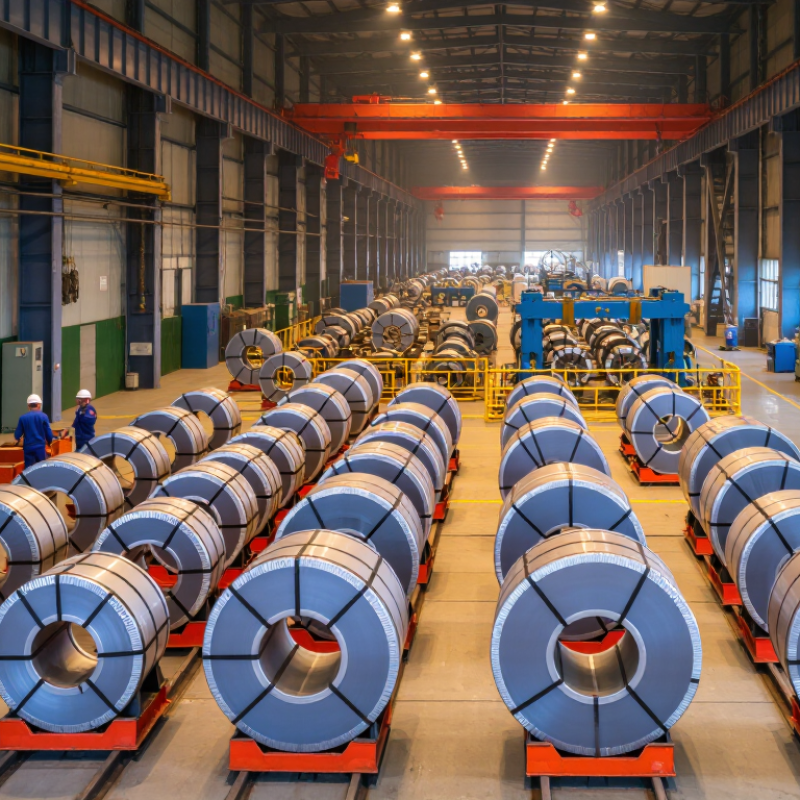
China Top 10 High Carbon Steel Coil Manufacturers?

High Carbon Steel Coil: Definition, Grades, and Key Properties

High-carbon steel coil is flat steel wound for transport and processing. Its carbon content commonly exceeds 0.60%, although exact limits vary by standard. Typical grades include C70, C75, C90, AISI 1070, and AISI 1095. Higher carbon increases hardness, tensile strength, and wear resistance. It also reduces ductility and makes welding more demanding.

The World Steel Association reported approximately 1.89 billion tonnes of crude steel production in 2023. China contributed about 1.02 billion tonnes, showing its major role in global steel supply. Yet production volume does not prove coil quality. Buyers should examine carbon uniformity, decarburization depth, surface defects, edge condition, and dimensional tolerance. ASTM and EN specifications provide useful testing frameworks, but they are not interchangeable without review.

Heat treatment strongly influences performance. Quenching can produce high hardness, while tempering improves toughness and reduces brittleness. AISI 1095 may suit blades, springs, and wear components, but it needs careful forming control. The USGS Mineral Commodity Summaries 2024 also highlights steel’s dependence on stable raw-material supply. That matters for consistent coil chemistry. In practice, one overlooked issue remains: a strong mill certificate cannot replace independent inspection. Tensile results may look excellent, while hidden edge cracks appear during stamping.

China’s High Carbon Steel Coil Manufacturing Landscape

China’s high carbon steel coil manufacturing landscape is broad, export-oriented, and increasingly technical. High carbon grades usually contain about 0.60% to 1.00% carbon, supporting springs, saw blades, cables, and wear-resistant components. According to the World Steel Association’s World Steel in Figures 2024, China produced about 1.02 billion tonnes of crude steel in 2023. This represented roughly half of global output. That scale supports large rolling mills, specialized heat-treatment lines, and flexible order volumes.

The strongest manufacturers typically compete through chemistry control, strip thickness accuracy, surface quality, and stable annealing performance. The China Iron and Steel Industry Association has repeatedly highlighted capacity optimization and quality upgrading as industry priorities. However, production scale does not guarantee consistent coil performance. Small variations in carbon content, cooling speed, or edge trimming can affect stamping results. A top-10 list should therefore compare test certificates, coil traceability, delivery records, and actual application experience. A ranking can be imperfect.

Tips: Ask for full mill certificates, tensile results, hardness data, and coil photographs. Confirm whether testing follows ASTM, EN, or JIS requirements. Request samples before signing a large contract. Check both center and edge properties. High carbon steel can look clean while hiding residual stress. That detail deserves attention.

Selection Criteria for Ranking the Top 10 Chinese Manufacturers

China Top 10 High Carbon Steel Coil Manufacturers?

A credible ranking should measure more than production volume or export claims. Selection begins with verified mill capacity, product range, and experience in high carbon steel grades. During supplier reviews, I check chemical certificates, heat numbers, and testing records. Carbon content must remain consistent across the coil. Small variations can affect hardness, forming, and service life.

Quality systems also deserve close attention. Auditors should review tensile strength, yield strength, elongation, surface condition, and dimensional tolerance. Independent laboratory results can support factory data. Traceability from raw material to finished coil improves reliability. Delivery history, packaging quality, technical support, and complaint handling also influence the ranking. Price alone misleads. A cheaper coil may create higher processing costs.

Tips: Request recent inspection reports, sample coils, and references from comparable applications. Visit the facility when possible. Ask how rejected material is controlled. No ranking is perfect. Public data can be incomplete, and factory conditions may change after an audit. The scoring method should therefore explain its evidence, weighting, and review date. That transparency helps buyers compare manufacturers with fewer assumptions.

China Top 10 High Carbon Steel Coil Manufacturers?
Selection Criteria for Ranking the Top 10 Chinese Manufacturers
No. Ranking Criterion Suggested Weight Verification Metric Preferred Benchmark Relevant Standard or Evidence Importance
1 Product Grade Coverage 15% Number of high-carbon grades and equivalent designations offered Coverage of carbon levels above approximately 0.60%, including grades such as 65Mn, 70, 75, 80 and 85 GB/T 1222 for spring steel; GB/T 711 and customer-approved specifications Critical
2 Chemical Composition Control 14% Heat-by-heat laboratory results for carbon, manganese, silicon, sulfur and phosphorus Results within the agreed grade tolerance, with sulfur and phosphorus controlled to the applicable specification Mill test certificates, spectrometer records and GB/T 223 chemical-analysis methods Critical
3 Dimensional Accuracy 12% Thickness, width, flatness, crown and coil shape consistency Conformance to the ordered tolerance under GB/T 709 or the buyer's approved dimensional schedule Calibrated gauges, statistical process control records and inspection reports Critical
4 Heat Treatment Capability 11% Availability of annealing, spheroidizing, normalizing or controlled cooling Documented thermal-cycle control and stable hardness or microstructure results across the coil Hardness testing, metallographic examination and process traceability records Critical
5 Mechanical Performance 11% Tensile strength, yield strength, elongation, hardness and bending performance All reported values meet the ordered grade and delivery condition without abnormal variation GB/T 228.1 tensile testing, GB/T 231.1 Brinell hardness and applicable product standard Critical
6 Surface and Internal Quality 10% Scale, cracks, laminations, inclusions, rust and edge-condition control No rejectable surface defects; internal quality verified when required by ultrasonic or inclusion testing Visual inspection, ultrasonic testing where specified and inclusion-rating records High
7 Production Capacity and Delivery 9% Monthly rolling capacity, minimum order quantity and on-time delivery performance Capacity suitable for repeat orders, documented lead times and reliable export packing capability Production records, shipment history, capacity statement and customer references High
8 Quality Management and Traceability 8% Traceability from raw material heat to finished coil and complaint-response capability Valid quality-management certification, retained inspection records and identifiable coil or heat numbers ISO 9001:2015 certificate, quality manual, corrective-action records and mill test certificates High
9 Export Compliance and Packaging 5% Export documentation, seaworthy packing, marking and container-loading procedures Moisture-resistant packaging, secure strapping, clear coil identification and complete shipping documents Packing specification, commercial documents, inspection certificate and applicable customs requirements Medium
10 Total Cost and Technical Support 5% Total delivered cost, technical communication, sampling and after-sales response Competitive landed cost without reducing grade compliance, documentation quality or service reliability Formal quotation, sample approval, technical data sheet and documented service response time Medium
Recommended evaluation method: Score each candidate from 0 to 100 for every criterion, multiply by the suggested weight, and rank the resulting weighted total. Final qualification should be based on current certificates, product samples, mill test certificates, independent inspection and customer references. Grade availability and technical requirements must be confirmed for each purchase order.

Top 10 High Carbon Steel Coil Manufacturers in China

China’s top 10 high carbon steel coil manufacturers are commonly assessed by production control, material consistency, and export experience. This group includes large mills, regional producers, and specialized rolling factories. Their products often contain 0.60% to 1.00% carbon. Typical thicknesses range from 0.20 to 12 millimeters. Widths may reach 1,500 millimeters, depending on the production line.

Reliable manufacturers usually provide heat numbers, mill test certificates, and chemical analysis reports. They also test tensile strength, hardness, elongation, and surface quality. Some facilities use continuous annealing or controlled cooling systems. These processes help reduce cracking during stamping, cutting, and forming. Buyers should inspect coil edges, rust protection, winding tightness, and weight tolerance before shipment. Small details can affect production costs.

The leading ten suppliers do not all offer equal performance. One may provide better flatness, while another delivers faster custom slitting. Some factories handle large export orders well but communicate poorly during technical changes. That weakness matters. Practical buyers should request recent samples, third-party inspection, and trial-order results. Factory audits can also verify furnace records, warehouse conditions, and packaging methods. A supplier ranking is useful, but it should not replace direct testing and careful contract review.

Applications, Quality Standards, and Export Considerations

When assessing China’s top ten high carbon steel coil manufacturers, buyers should examine applications, quality control, and export readiness rather than production volume alone. World Steel Association data recorded China’s crude steel output at about 1,005 million tonnes in 2024. This scale supports broad coil availability, but capacity does not automatically prove consistency.

High carbon steel coil serves saw blades, springs, agricultural tools, knives, and wear-resistant components. Buyers should confirm carbon content, hardness, tensile strength, decarburization depth, and surface condition. ASTM A684 covers high-carbon steel strip requirements, while EN 10132-4 addresses cold-rolled spring steels. ISO 9001 certification helps assess process management, but it is not a substitute for batch testing. Ask for an EN 10204 3.1 inspection certificate, heat number traceability, and test results from an accredited laboratory. Small gaps matter. A slightly uneven edge can disrupt slitting or stamping.

Tips: Compare samples from three suppliers before signing. Specify coil width, thickness tolerance, hardness range, oiling, packaging, and allowable telescoping. Confirm the correct HS classification with a customs broker, because product chemistry and dimensions can change tariff treatment. Request photos of seaworthy packaging, including edge protectors and moisture barriers. Review Incoterms 2020, loading-port documents, and insurance responsibilities in writing. Export lead times can look attractive on paper, yet port congestion and reinspection may alter the schedule. Allow contingency time.

China Top 10 High Carbon Steel Coil Manufacturers

Applications, Quality Standards, and Export Considerations

The chart compares representative carbon-content midpoints for widely used high-carbon steel grades referenced in EN, ASTM/SAE, JIS, and Chinese standards. Higher carbon content generally supports greater hardness and wear resistance after heat treatment, while lower-carbon grades provide improved forming and toughness. Typical applications include springs, saw blades, knives, scrapers, wear strips, and stamping components. Export buyers should verify the applicable standard, chemical composition, mechanical properties, surface condition, coil dimensions, mill test certificate, packing, and certificate-of-origin requirements before ordering.

Values shown are representative nominal midpoints of standard grade ranges; exact limits may vary by grade designation, product form, and edition of the applicable standard.