Please upgrade your web browser now. Internet Explorer 6 is no longer supported.>

What Are the Top 10 Types of Steel Parking Bollards?

Steel Parking Bollards can look simple: a steel post, a base plate, and a few anchor bolts. Yet the right choice depends on the site. A hotel entrance needs a different solution from a loading bay or a narrow sidewalk. Wall thickness, diameter, height, finish, and installation method all affect performance and upkeep.

This guide compares ten common types, including fixed, removable, retractable, surface-mounted, and decorative bollards. It considers where each type fits, what details to check, and what trade-offs may matter. A thick post is not automatically the best post. Vehicle exposure, pedestrian clearance, soil conditions, and maintenance access all deserve attention. Small details count. A poorly placed bollard can obstruct a route or leave a vulnerable gap.

No source article or verifiable expert quotation was provided, so attributing a statement to a real specialist would risk inventing a claim. For editorial development, a draft line for a verified expert to review is: “Choose the bollard for the site’s actual risks and installation conditions, not appearance alone.” Confirm both the wording and the expert’s name before publication. That check matters. Even a useful overview has limits; local site assessment and manufacturer specifications should guide final selection.
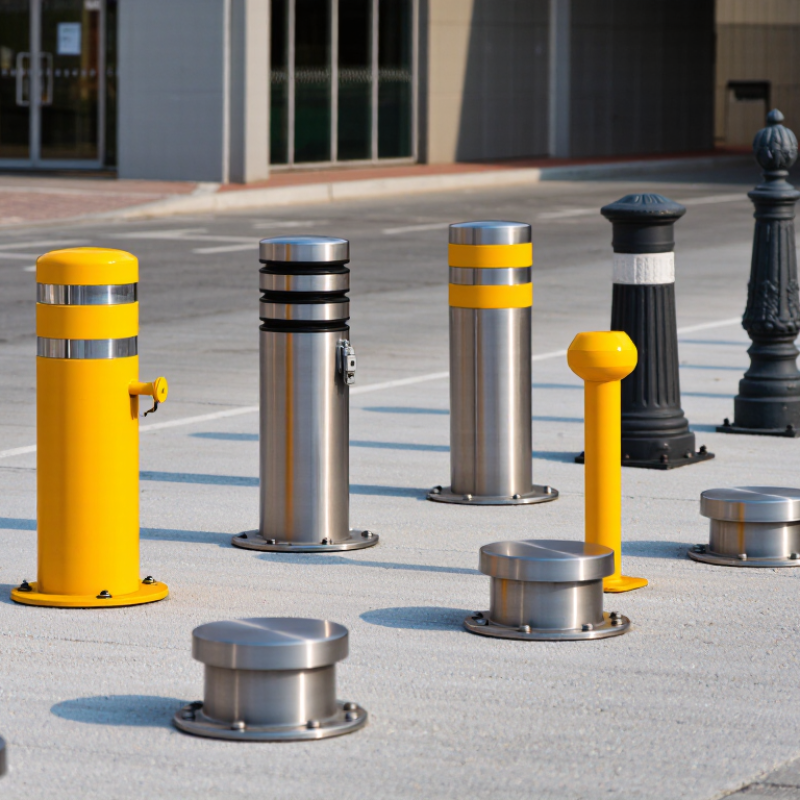
What Are the Top 10 Types of Steel Parking Bollards?

Define Steel Bollards by Function, Mounting, and ASTM A500 Grade C (50 ksi)

Steel parking bollards can be classified by what they do and how they attach. Ten common types are fixed, surface-mounted, removable, retractable, hinged, telescoping, security-focused, traffic-guidance, pedestrian-protection, and architectural bollards. These labels can overlap: a fixed bollard may also provide vehicle-impact protection. Function determines placement, spacing, and whether access must remain open.

Mounting changes the installation. Embedded bollards extend below pavement into a concrete footing, while surface-mounted units use base plates and anchors on existing concrete. Removable models fit sleeves, and retractable designs lower into the ground. Hinged units fold down for occasional access. Check slab thickness, footing dimensions, drainage, and underground services before choosing a mounting method. A base plate can look sturdy but still be poorly matched to the slab.

ASTM A500 Grade C is a specification for cold-formed carbon-steel structural tubing, not a bollard performance rating. For round tubing, Grade C has a minimum yield strength of 50 ksi; square and rectangular sections have a different specified minimum. That distinction matters. Confirm the tube shape, wall thickness, and material documentation rather than relying on “50 ksi” alone. Also assess the finished bollard, welds, anchors, and installation for the intended site. A careful field check can reveal details a clean drawing misses.

Compare Fixed, Removable, Retractable, Automatic-Rising, and Telescoping Bollards

Steel parking bollards differ less by appearance than by how often access must change. Fixed bollards offer continuous protection at entrances, sidewalks, and loading areas, but restrict vehicle access permanently. Removable models lift from ground sleeves when occasional access is needed; operators must store each post safely. Manual retractable bollards lower into a below-ground housing, while automatic-rising units use powered mechanisms for frequent, controlled entry. Telescoping bollards extend from compact housings, saving space, though dirt and poor drainage can affect smooth operation. Access changes everything.

Selection should reflect traffic frequency, site conditions, and the required impact performance. ASTM F3016/F3016M tests low-speed vehicle barriers at 10, 20, and 30 mph; ASTM F2656/F2656M evaluates vehicle-security barriers at 30, 40, and 50 mph. These are test conditions, not guarantees for every steel post. A rating applies to the tested barrier configuration, including its foundation and installation. Automatic systems need a plan for power loss and maintenance; fixed posts need careful placement to avoid blocking pedestrian routes. The trade-off is easy to miss: a stronger barrier can still create awkward daily access. A site review helps expose that gap.

Compare Embedded, Surface-Mounted, Crash-Rated, Decorative, and Sleeve Bollards

Steel parking bollards differ less by appearance than by how they connect to the pavement and handle impact. Embedded models extend below grade into concrete, making them a strong choice for fixed protection near entrances. Installation is disruptive, though, and hidden foundations can complicate later repairs. Plan before paving.

Surface-mounted bollards attach to an existing slab with base plates and anchors. They suit retrofit projects, but performance depends on slab thickness, anchor spacing, and installation quality. Crash-rated units are tested under defined impact conditions; the rating should match the site's risk and layout. Not every sturdy-looking post is crash-rated. That distinction matters.

Decorative steel bollards add visual order around walkways, storefronts, or landscaped edges, yet appearance alone says little about impact resistance. A sleeve slips over a compatible post, refreshing its color or visibility without replacing the steel core. Check fit, drainage, and clearance; a loose sleeve can rattle, an easy detail to overlook. There is no perfect option: even a well-chosen post may narrow a busy walkway if spacing is poorly planned.

Interpret ASTM F2656 Crash Ratings, Including M30/P1 and M50/P1 Classes

What Are the Top 10 Types of Steel Parking Bollards?

ASTM F2656 crash ratings help compare how vehicle barriers perform under defined impact tests. In a rating such as M30/P1, M30 identifies a medium-duty vehicle test at 30 miles per hour. M50/P1 indicates the same vehicle class tested at 50 miles per hour. The P1 code describes the tested penetration limit: no more than 1 meter beyond the barrier line. It does not mean every bollard installation will stop every vehicle in the same way.

For fixed steel bollards, removable units, or other designs, look for the full test report—not just a rating printed in a product description. Check the tested bollard spacing, foundation, soil conditions, and installation details. A P1 result depends on the specific tested system. A different footing or layout may change performance. Ratings are useful, but site conditions still complicate the choice.

Tips: Match the rating to the site’s vehicle threat and available setback. Check that installation details match the tested configuration. Ask what the report measures, and remember that a rating is not a guarantee. The distinction matters.

What Are the Top 10 Types of Steel Parking Bollards? — Interpret ASTM F2656 Crash Ratings, Including M30/P1 and M50/P1 Classes
Bollard type Typical construction and dimensions Installation and operation Common use Crash-rating considerations
1. Deep-foundation fixed steel pipe Structural steel pipe, commonly around 4–8 in (102–203 mm) in diameter; exposed height often about 30–48 in (760–1,220 mm). Foundation depth and pipe specification are site-specific. Set into an engineered concrete foundation; remains in place. Perimeter protection, building approaches, and vehicle-access control. A suitable basis for a tested barrier design. M30/P1 or M50/P1 applies only if the complete installed configuration achieves that result in an applicable crash test.
2. Concrete-filled fixed pipe Hollow steel pipe filled with concrete; pipe diameter, wall, fill, and height vary by design. Common above-ground heights are approximately 30–48 in (760–1,220 mm). Usually embedded in a concrete footing; the fill adds mass but does not by itself establish crash performance. Parking-lot edges, storefronts, utilities, and pedestrian areas. Do not infer an ASTM rating from concrete fill, pipe size, or appearance. A rating requires testing of the specified assembly and foundation.
3. Shallow-mount fixed steel bollard Steel post connected to a compact engineered foundation; visible height is commonly in the 30–48 in (760–1,220 mm) range. Foundation dimensions depend on the design and soil or pavement conditions. Fixed in a shallower excavation than a conventional deep foundation; requires suitable substrate and installation details. Sites with limited excavation depth, such as locations near underground services. Shallow mounting does not automatically mean crash-rated. Check the tested foundation, anchors, substrate, and installation limits.
4. Removable socket-mounted steel bollard Steel post fits into a ground socket; common post sizes are selected for the access-control need and are not standardized crash dimensions. Lifted out when access is needed; a cover or cap can protect the socket when the post is removed. Occasional vehicle access, service routes, and shared-use spaces. Most removable posts are access-control devices, not certified vehicle barriers. Accept a crash class only where the exact post, socket, foundation, and locking method were tested together.
5. Manual retractable steel bollard Telescoping steel post that lowers into a below-ground housing; dimensions vary by product and required clear opening. Raised and lowered by an operator, typically using a lock or manual mechanism. Low-frequency access points where powered equipment is unnecessary. A retractable post is not inherently crash-rated. Any claimed rating must cover the raised position and the complete installed system.
6. Automatic retractable steel bollard Steel post in a powered below-ground housing; post diameter, travel, and housing vary by system. Raised and lowered by an electric, hydraulic, or other powered mechanism; requires controls and suitable site services. Controlled vehicle entrances with frequent, managed access. Check whether testing covers the bollard in its raised position, the housing, foundation, and any operating components relevant to the tested configuration.
7. Surface-mounted steel bollard Steel post attached to a base plate; plate size, anchor pattern, and post dimensions vary by design. Anchored to an existing slab or structural surface; the supporting concrete and anchors are critical. Light-duty delineation or sites where below-ground excavation is not practical. A bolted base plate alone does not demonstrate crash resistance. Verify the tested surface, concrete thickness, anchors, and installation instructions.
8. Decorative steel bollard with structural core Structural steel post or core with a decorative steel outer profile; overall shape and finish can vary. Usually fixed into a foundation; decorative parts may be separate from the load-bearing element. Civic spaces, campuses, streetscapes, and commercial entrances. Decorative appearance does not indicate a crash class. Confirm that the tested configuration includes the core, outer components, foundation, and spacing.
9. Modular or bolt-down steel barrier bollard Steel posts and connected modules or base components; module lengths, post spacing, and anchoring details depend on the system. Assembled and anchored on site; can provide a continuous or linked barrier layout. Long frontage, loading areas, and access-control layouts needing repeatable spacing. Only the tested module arrangement, end conditions, anchors, and installation should be treated as rated. Changes can affect performance.
10. Flexible or energy-absorbing steel bollard Steel post or steel-supported assembly designed to deflect or absorb some impact energy; geometry and movement vary by design. Typically fixed to a foundation; some designs are intended to return toward their original position after minor impacts. Parking areas, pedestrian routes, and locations with frequent low-speed contact. Designed flexibility is not equivalent to an ASTM vehicle-barrier rating. Require a relevant crash-test result if vehicle-penetration performance is needed.
How to read the ASTM F2656 classes: The M-series number identifies the test impact speed in miles per hour: for example, M30 is 30 mph and M50 is 50 mph. The penetration code describes the tested vehicle’s penetration distance. P1 corresponds to 1.0–7.0 m (approximately 3.3–23 ft). Thus, M30/P1 and M50/P1 describe different tested performance levels; neither rating is guaranteed by bollard type, material, diameter, or appearance alone. Confirm the applicable ASTM F2656 edition and the complete tested configuration, including foundation, soil or pavement conditions, spacing, and installation.

Dimension note: Dimensions shown as typical ranges are illustrative, not ASTM requirements or universal product specifications. Final selection should account for vehicle access, site conditions, accessibility, drainage, utilities, and the required level of protection.

Check Site Layout Against the ADA’s 36-in Accessible-Route Minimum

What Are the Top 10 Types of Steel Parking Bollards?
Check Site Layout Against the ADA’s 36-in Accessible-Route Minimum

Steel bollards may be fixed, removable, retractable, surface-mounted, embedded, decorative, sleeved, pipe-style, security-rated, or lighted. Their function matters, but so does their placement. A bollard can protect a doorway or guide traffic while narrowing a pedestrian route. ADA Standards generally require at least 36 inches of clear width on an accessible route, with specific exceptions. Measure the usable space between obstacles, not just the distance between bollard centers. Small shifts matter.

Tips: Mark the proposed bollard footprints with tape before installation. Measure clear width around bases, signs, parked vehicles, and door swings. Check the route where people actually walk, including near curb ramps and entrances. Measure twice.

A plan that shows 36 inches may leave less room on site. Base plates, uneven pavement, and temporary displays can reduce the clear passage. Walk the route with a tape measure at several points, especially at turns and pinch points. If the layout feels tight, adjust spacing or consult a qualified accessibility professional before drilling. It is easy to miss a few inches on paper. Don’t rely on visual estimates.

What Are the Top 10 Types of Steel Parking Bollards?

Common configurations include embedded fixed, surface-mounted fixed, removable, retractable, telescoping, hinged, crash-rated, decorative, lighted, and sleeve-covered steel bollards. The chart shows ADA route-width dimensions to check when laying them out.

Layout note: An accessible route generally requires 36 inches of clear width. A 32-inch minimum is permitted only for a segment no longer than 24 inches, subject to ADA conditions. Where a route narrower than 60 inches requires passing spaces, those spaces are 60 by 60 inches and are provided at intervals no greater than 200 feet. Measure clear width between obstructions, including bollards.