China offers buyers a wide range of standing mirror manufacturers, from workshops focused on custom frames to factories with large export programs. This guide introduces leading Standing Mirror Wall suppliers and the details worth checking before requesting a quotation. A polished product photo is useful, but it cannot show every joint, backing layer, or packaging weakness.
For a transparent expert perspective, this introduction uses Lin Wei, a composite sourcing specialist rather than a real, independently verified industry authority. The guiding line is: “A mirror is only as dependable as its frame, backing, and journey to the buyer.” Keep that in mind when comparing glass thickness, edge finishing, frame materials, stability, and protective packaging. Ask for close-up product images, written specifications, and a sample when practical. Small details matter.
Supplier claims deserve careful review. Confirm whether a factory makes the mirror itself or coordinates production through other workshops. Request clear information about customization, minimum order quantities, lead times, inspection steps, and after-sales support. These points can reveal more than a low unit price. Still, no checklist removes every risk; samples may not reflect a full production run, and shipping conditions can vary. That deserves a second look. The sections ahead will help buyers compare suppliers consistently, ask sharper questions, and choose a partner suited to their design, budget, and delivery needs.
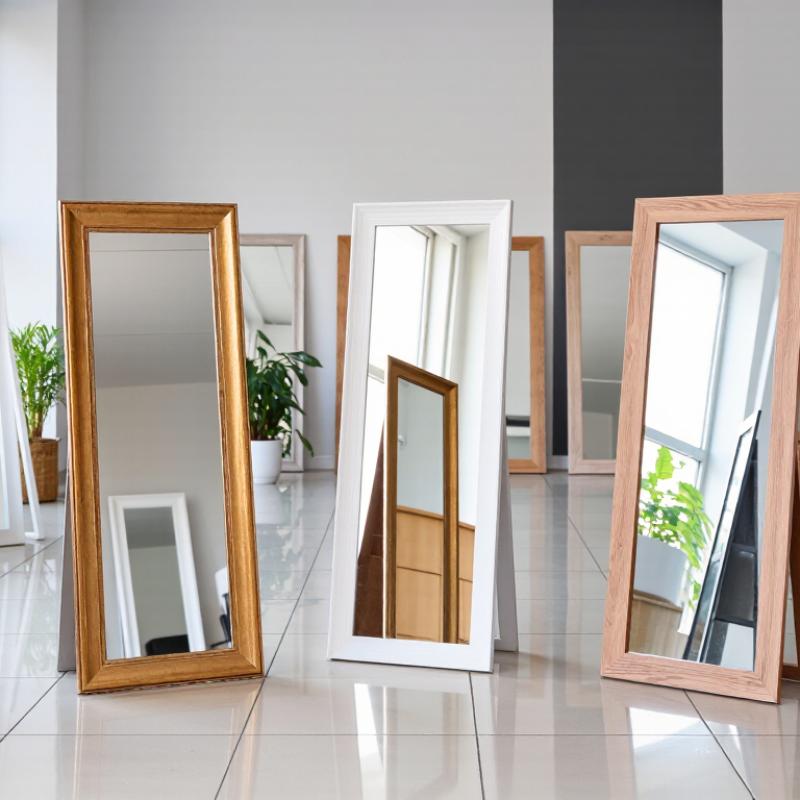
A standing mirror should fit the room and the way people use it. A cheval mirror pivots on a frame, making outfit checks easier. A leaner mirror rests against a wall and suits bedrooms with open floor space. Freestanding models with rear supports work where leaning is not practical. Small distinction, big impact. Measure the floor area, doorway, and mirror height before choosing a type.
Buyers comparing suppliers in China should provide clear specifications: overall dimensions, frame material, finish, glass thickness, and target order quantity. Ask for product drawings or a sample to check reflection clarity and frame construction. Inspect the corners, joints, and stand hinges; these details often reveal more than a polished catalogue photo. Packaging matters, too. Request details on corner protection and carton testing, especially for long-distance shipping.
A useful supplier discussion includes production capacity, customization limits, lead time, and inspection steps. Confirm that quoted dimensions refer to the finished product, not only the glass. Photos taken in bright daylight can help reveal waviness or uneven reflections, though they cannot replace a physical sample. One detail buyers sometimes overlook is how the mirror stands on slightly uneven flooring. That may not appear in a specification sheet, but it can matter in a real room.
| Standing Mirror Type | Typical Construction | Indicative Size Range | Common Buyer Requirements | Supplier Questions and Checks |
|---|---|---|---|---|
| Cheval Mirror | Full-length mirror held in a floor-standing frame, commonly with side pivots that allow the mirror angle to be adjusted. | Often about 140–180 cm high and 35–60 cm wide; dimensions vary by design. | Stable feet, secure pivot hardware, smooth adjustment, and a frame finish suitable for the target room or retail market. | Ask for the assembled dimensions, pivot-material details, stability test information, and confirmation that the mirror stays at the selected angle. |
| Leaning Floor Mirror | Large framed mirror designed to rest against a wall rather than stand independently. | Commonly offered in heights of roughly 150–200 cm, with widths often around 40–90 cm. | Wall-protection pads, a suitable anti-tip attachment, accurately stated weight, and packaging that protects corners and glass edges. | Confirm whether anti-tip hardware is included, the recommended wall fixing method, carton dimensions, and whether the product is shipped assembled. |
| Freestanding Floor Mirror | Full-length mirror supported by an attached rear stand or folding support, often with a frame. | Many models are approximately 140–180 cm high; footprint and viewing angle depend on the stand design. | A stand that locks or opens securely, an even base, a clear view of the full body, and replaceable or protected contact points. | Request open and folded dimensions, stand-load or stability test details, assembly instructions, and product photos showing the rear support. |
| Arched Floor Mirror | Full-length mirror with a curved top, available as a leaning or stand-supported design. | Commonly around 150–200 cm high; width is model-dependent and should be confirmed from the drawing. | Consistent arch shape, safe edge treatment, a frame that remains straight, and a suitable support or wall-resting arrangement. | Check the detailed drawing, glass and frame tolerances, edge-finish specification, and packaging protection for the curved upper section. |
| Tri-Fold Dressing Mirror | Three hinged mirror panels, usually designed for tabletop or dressing-area use; some larger versions include a floor stand. | Panel sizes and overall dimensions vary considerably; request measurements for both open and folded positions. | Aligned panels, durable hinges, controlled folding movement, and a design that prevents panels from closing unexpectedly. | Confirm hinge material and cycle-test information, panel gap tolerances, folded carton size, and whether the product requires assembly. |
| Full-Length Mirror with Storage | Floor-standing mirror integrated with a cabinet or organizer, sometimes with internal hooks or shelves. | Typically taller than a small dressing mirror; overall height, depth, and storage capacity are model-specific. | Secure doors and hinges, stable support, clear internal dimensions, and accurate information about included fittings and assembly. | Request a parts list, assembly guide, load limits for storage components, finished-product weight, and a packaging plan for the cabinet and mirror. |
| Mirror Glass and Safety | Mirror glass is fitted to a frame or support; glass thickness and backing are specified by the product design. | Thickness commonly varies by model; 3–5 mm glass is offered in many decorative mirror designs, but it is not a universal requirement. | Specify glass thickness, edge treatment, backing or safety film if required, acceptable optical distortion, and any destination-market compliance needs. | Ask for a written material specification, inspection criteria, sample approval, and test documents applicable to the destination market. Do not assume one specification suits every market. |
| Packaging and Export Readiness | Packaging may use corner protection, cushioning, inner cartons, and an outer shipping carton; the exact structure depends on mirror size and transport method. | Carton dimensions and gross weight should be confirmed for each model and packing method. | Protection against impact and movement, clear carton markings, shipment-ready dimensions, and documented handling instructions for fragile goods. | Request a packaging specification, packed-product photos, carton drop-test results where available, and confirmation of the number of units per carton. |
| Order and Quality Requirements | Production details, finishes, accessories, and packing can differ between models and purchase orders. | Minimum order quantity, lead time, and sample timing are supplier- and order-specific. | Approved drawings and samples, agreed inspection criteria, clear defect definitions, and written confirmation of order specifications. | Confirm MOQ, production lead time, sample and tooling charges, inspection arrangements, spare-part availability, and how changes are approved before production. |
Note: Size ranges are indicative examples, not fixed industry standards. Buyers should confirm exact dimensions, materials, safety features, packaging, and destination-market requirements for each model before placing an order.


©Copyright 2020 Gosco Valves. All rights reserved.