Global automation is moving toward faster, cleaner, and more repeatable motion systems. The International Federation of Robotics reported 541,302 industrial robots installed worldwide in 2023. Behind many robotic cells are simple mechanical elements, including shafts, bearings, guides, and fastening systems. A correctly selected Threaded Linear Shaft can support positioning, alignment, adjustment, and compact structural movement in demanding equipment.
This guide introduces ten threaded shaft types for global buyers. It considers thread form, shaft material, surface treatment, dimensional accuracy, load direction, and installation environment. Stainless steel options suit washdown areas, while hardened carbon steel can offer stronger wear resistance. Hollow designs may reduce weight, but they can require stricter support planning. Small details matter. Even thread contamination can damage assembly accuracy.
Market research from Grand View Research and MarketsandMarkets continues to identify industrial automation as a major growth area. These reports do not measure every shaft application directly. That limitation matters. A broad automation forecast cannot replace engineering validation for one machine. ISO 286 fits and tolerances, ISO 1302 surface-texture guidance, and supplier inspection records remain essential reference points. Buyers should request material certificates, thread gauges, straightness data, and coating specifications before placing volume orders.
No single shaft type wins everywhere. That assumption can fail. A low-cost part may create higher maintenance costs later. Conversely, an over-engineered shaft may waste budget and installation space. The following selection offers a practical comparison for engineers, distributors, and sourcing teams. It focuses on real purchasing decisions, including corrosion exposure, machining quality, replacement availability, and international supply reliability.
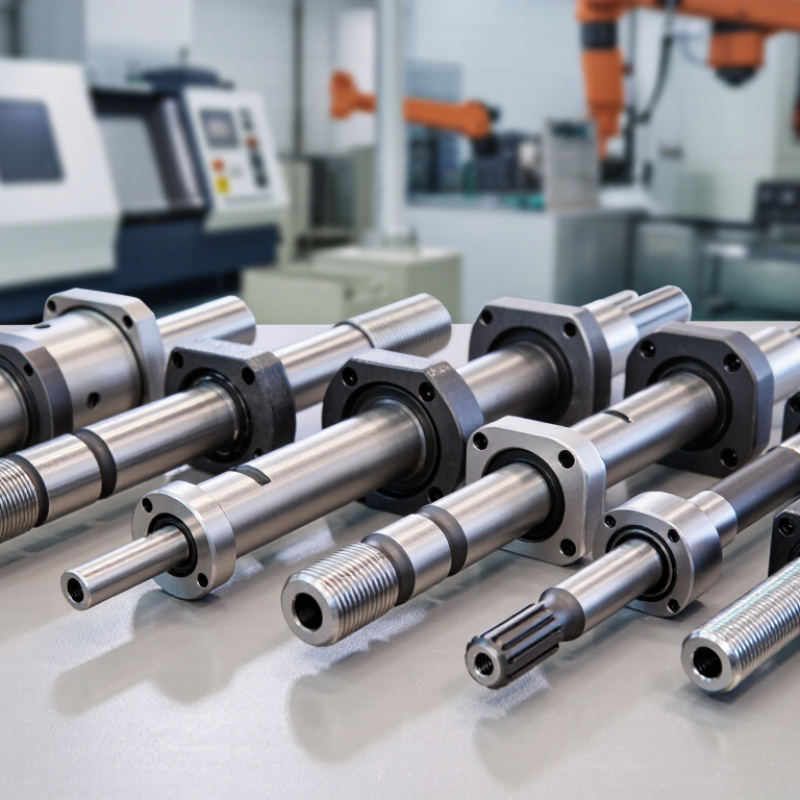
Top 10 Threaded Linear Shaft Types for Global Buyers
Threaded linear shafts convert rotary motion into controlled linear travel. Their performance depends on load, lead, pitch, and accuracy. Axial load pushes along the shaft, while radial load bends it. These forces should be calculated separately, not casually combined. A long shaft may fail through buckling before its threads reach their rated capacity. Keep the working load below the calculated limit.
Lead describes travel per revolution. Pitch measures the distance between neighboring thread crests. For a single-start thread, lead equals pitch. Multi-start threads create greater travel per revolution, but they can reduce mechanical advantage. A 5 mm lead moves five millimeters during one rotation. The motor, speed, and required thrust must match this relationship. Small pitch suits controlled positioning; larger lead supports faster movement.
Accuracy needs more than a catalog tolerance. Check lead error, repeatability, straightness, runout, and backlash. Preload can reduce backlash, but excessive preload increases friction and heat. In practical testing, I measure travel at several shaft positions, then reverse direction. The results are often less perfect than expected. A spreadsheet may look convincing, yet mounting misalignment can distort the measurement. I also confirm whether specifications use millimeters or inches. That detail seems minor, but it can ruin an otherwise careful design.
Top 10 Threaded Linear Shaft Types for Global Buyers
The word “shaft” is convenient, but technically imprecise. In many applications, these parts are threaded lead screws or power screws. Acme profiles follow ASME B1.5, using a 29-degree included angle. ISO 2901–2904 define metric trapezoidal threads with a 30-degree profile. That one-degree difference affects nut engagement, tooling, and inspection methods.
Small details matter. Measure the pitch diameter, lead, flank angle, and straightness before selecting a supplier. ISO 2902 covers general dimensions, while ISO 2903 addresses tolerances and gauging. A 16 mm trapezoidal screw with a 4 mm lead may suit compact actuators. A larger 30 mm screw can deliver higher thrust, but it also increases inertia and manual effort. Do not treat nominal diameter as load capacity.
The International Federation of Robotics reported 541,302 industrial robot installations worldwide in 2023. That volume reflects continuing demand for repeatable linear motion components. It does not prove every shaft needs precision grinding. That assumption can waste money. Rolled threads often provide practical consistency, while machined or ground threads may support tighter positioning requirements. Acme designs remain common in inch-based equipment. Trapezoidal designs simplify metric sourcing across international plants. Thread fit, lubrication, duty cycle, and unsupported length still require engineering review. Standards help. They do not replace testing.
Metric and inch threaded shafts serve different inspection and fit requirements. ISO 965-1 applies to metric ISO threads, not inch threads. For a metric shaft, an external 6g tolerance class is a common starting point. Its matching internal thread often uses 6H. This pairing normally provides practical clearance for assembly.
Fit selection depends on more than the class marking. A shaft with a 6g thread may feel tight after plating, paint, or repeated exposure to dust. Measure the pitch diameter, thread major diameter, and pitch with calibrated tools. Check the mating nut under the same temperature conditions. Small thermal changes can affect a long linear shaft.
Inch shafts require Unified thread specifications, with classes such as 2A and 3A for external threads. Class 2A suits many general assemblies, while 3A offers tighter control and less clearance. It is not automatically better. A tight fit can resist adjustment and collect debris near a sliding carriage. Coarse threads often tolerate contamination better, while fine threads support smaller axial adjustments.
Use the shaft’s load, travel, lubrication, and maintenance conditions to choose the fit. A shoulder, relief groove, or chamfer can prevent interference at the thread runout. The drawing should state diameter, pitch, tolerance class, length, surface treatment, and inspection method. One detail is easy to miss: coating thickness changes the effective thread size. Recheck it before approving production.
Global buyers often compare rolled, ground, ball-screw, and lead-screw shafts by appearance. That can mislead. ISO 3408 primarily covers ball-screw assemblies, including dimensions, accuracy, testing, and acceptance conditions. It does not classify every threaded linear shaft. Always request the exact standard edition and inspection report.
Ten practical types appear frequently in industrial purchasing: rolled ball screws, ground ball screws, precision ground screws, transport ball screws, miniature ball screws, large-diameter ball screws, hollow ball screws, trapezoidal lead screws, acme lead screws, and stainless threaded shafts. Rolled screws usually reduce cost and suit general automation. Ground screws offer tighter motion control, but their price and delivery time increase. Ball-screw designs use circulating balls, so they normally provide higher efficiency than sliding lead screws.
Lead screws remain useful for compact actuators, clamps, and low-speed positioning. Their sliding contact can tolerate simpler systems, yet heat and wear need attention. Trapezoidal profiles are common in metric equipment. Acme profiles may support easier regional replacement, depending on local engineering practice. ISO 3408 data should be checked for nominal diameter, lead, lead accuracy, preload, axial play, and permissible variation. A catalog value is not enough.
In practice, shaft straightness can affect performance more than expected. Dirt near the nut also changes the result. A careful buyer asks for material, hardness, lubrication guidance, runout limits, and measured accuracy. Some suppliers describe a shaft as “precision” without stating the test method. That wording deserves review. The overlooked detail is often the most expensive one.
Global buyers often compare ten shaft types: 304, 316, precipitation-hardened stainless, carbon steel, alloy steel, chrome-plated, zinc-coated, nitrided, hollow, and precision-ground shafts. Material selection should begin with load, corrosion exposure, thread stress, and required straightness. ASTM references help, but they do not replace a complete purchase specification.
For stainless bars, ASTM A276 can support grade and dimensional requirements, while ASTM A967 helps define chemical passivation practices. Grade 316 suits chloride-rich environments better than 304, although it still requires careful maintenance. Alloy and carbon steel bars may follow ASTM A29, with heat treatment and mechanical properties confirmed separately. For hollow shafts, ASTM A519 may apply to seamless mechanical tubing, but the tube grade, wall thickness, and thread design must match the actual load.
Coatings need independent verification. Salt-spray results under ASTM B117 show comparative corrosion performance, not guaranteed service life. Coating adhesion can be checked through ASTM D3359 methods, when applicable. Surface hardness, runout, and thread gauges should appear on inspection records.
In practice, I have seen excellent materials fail because threads were cut after poor heat treatment. That detail is easy to miss. Buyers should request mill certificates, hardness data, dimensional reports, and traceable lot numbers. ASTM compliance sounds reassuring, but the exact grade, product form, condition, and test method still need review.
1272 Speers Rd Unit 4
Oakville ON Canada L6L 2X4
©Copyright 2020 Gosco Valves. All rights reserved.